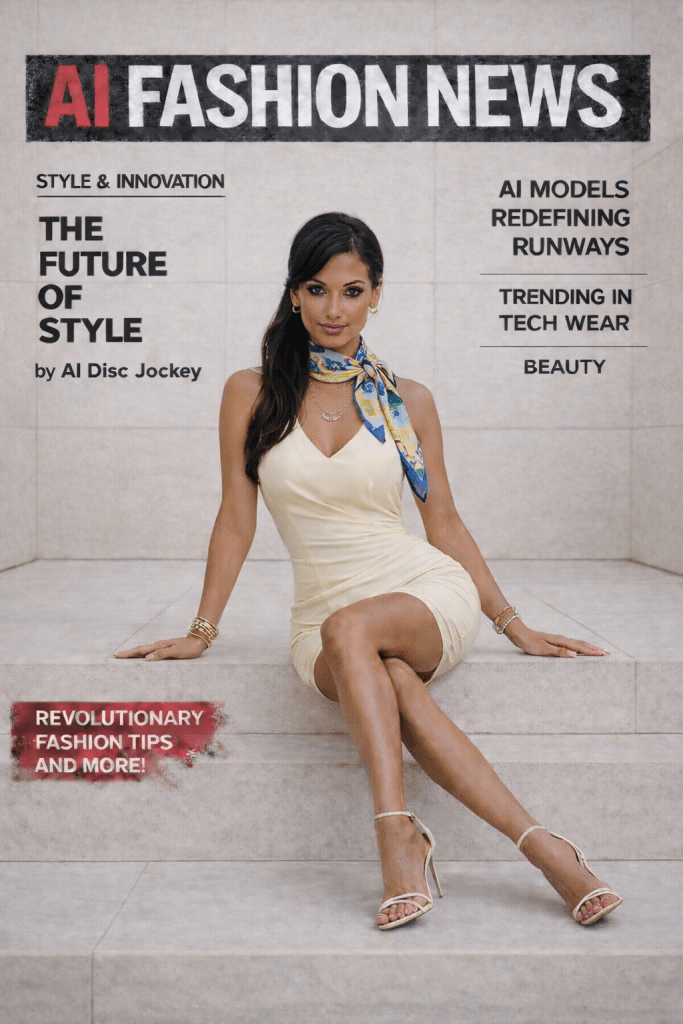
By AI Disc Jockey
Introduction: From Utility to Identity
There was a time—not long ago—when technology companies competed on speed, scale, and functionality. The value proposition was clear: build faster processors, smarter software, and more powerful platforms. But today, something far more profound is unfolding.
Big Tech is no longer content with being useful. It wants to be desirable. It wants to be worn, experienced, and—most importantly—felt.
According to Vogue, technology giants are increasingly adopting the strategies of luxury fashion houses—investing in physical retail, cultural storytelling, and aesthetic identity to elevate their products beyond mere tools.
What we are witnessing is not just convergence. It is a category shift. AI is moving from infrastructure to identity. And in doing so, it is entering fashion’s most sacred territory: meaning.
The Fifth Avenue Moment: Tech Enters Fashion’s Cathedral
Perhaps no signal is clearer than Meta’s decision to plant its flag on Fifth Avenue—arguably the most symbolic retail corridor in the world. This is not just real estate; it is positioning.
As Vogue reports, Meta’s flagship store is designed not as a showroom, but as an immersive, experiential space that reflects creativity and community.
This is straight out of the luxury playbook.
For decades, brands like Prada and Gucci have understood that retail is theater. The store is not just where you buy—it is where you belong. By stepping into this world, Meta is making a statement: its AI-powered products, including smart glasses, are not gadgets. They are lifestyle artifacts.
This shift reframes the role of technology entirely. No longer just functional, it becomes symbolic—a marker of identity, taste, and cultural alignment.
From Devices to Statements: AI as Social Currency
The transformation doesn’t stop at retail. It extends into how products themselves are conceived and positioned.
AI-powered wearables—particularly smart glasses—are being developed not only for capability, but for wearability. They must look good, feel natural, and integrate seamlessly into personal style.
This mirrors the evolution of sneakers in the early 2000s. Once purely athletic gear, they became status symbols—objects that communicated tribe, taste, and aspiration.
Today, AI devices are on a similar trajectory.
As Vogue notes, these products are increasingly framed as identity markers and status symbols, rather than just tools.
In other words:
AI is becoming something you are, not just something you use.
The Fashionization of Tech: Storytelling, Not Specs
One of the most important shifts happening beneath the surface is the move from technical marketing to narrative-driven branding.
Tech companies are now borrowing heavily from fashion’s world-building approach:
- Collaborations with creatives and designers
- Branded merchandise and pop-ups
- Campaigns rooted in emotion and culture
Even companies like OpenAI and Anthropic are experimenting with storytelling strategies that mirror fashion campaigns—placing emphasis on human connection, imagination, and possibility.
This is a fundamental departure from traditional tech communication, which prioritized features and performance metrics.
Fashion has always understood something tech is now learning:
People don’t buy products. They buy narratives about themselves.
The Invisible Layer: When Technology Disappears Into Design
At the same time, there is a parallel movement toward invisibility.
Wearable technology brands are increasingly embedding AI into garments and accessories in ways that are subtle, seamless, and almost imperceptible.
This reflects a deeper philosophical shift:
- The best technology is not seen
- It is felt
This aligns with broader predictions in fashion-tech, where AI is expected to operate primarily behind the scenes, powering personalization, prediction, and production while leaving the visible layer to human expression.
In this model, AI becomes the engine—but fashion remains the interface.
The Backlash: When Too Much AI Becomes “Slop”
Yet, as AI moves into fashion’s front stage, resistance is emerging.
Vogue highlights a growing backlash against what critics call “AI slop”—a term used to describe generic, low-effort AI-generated visuals that lack authenticity and craft.
Consumers are becoming more discerning. They can sense when something is overproduced, over-automated, or emotionally hollow.
Luxury brands, in particular, face a paradox:
- AI offers efficiency and scale
- But luxury is built on scarcity, craftsmanship, and human touch
To reconcile this, many brands are adopting a hybrid approach—using AI behind the scenes while emphasizing visible human creativity in campaigns and storytelling.
This suggests a future where the value of fashion lies not in what is produced, but in how it is perceived.
The Cultural Pivot: Tech Learns Emotion
What makes this moment so significant is not just that tech is entering fashion—but that it is learning from it.
Fashion operates on a different set of rules:
- It prioritizes emotion over logic
- Identity over utility
- Culture over capability
By adopting these principles, tech companies are undergoing a kind of transformation. They are becoming cultural entities, not just technological ones.
This shift is also reflected in the broader fashion landscape, where designers are increasingly grappling with technology’s role in creativity and identity.
The question is no longer whether AI belongs in fashion.
It is how it can coexist with human meaning.
The New Battleground: Authenticity vs. Augmentation
As AI becomes more embedded in fashion, a new strategic divide is emerging.
On one side:
- Brands that embrace AI fully
- Leaning into hyper-creation, synthetic imagery, and digital-first experiences
On the other:
- Brands that emphasize authenticity
- Highlighting real people, real craft, and human imperfection
This tension is not a weakness—it is the engine of innovation.
As one Vogue-linked analysis puts it, how a brand uses (or refuses) AI signals what it values: “speed vs. meaning, spectacle vs. intimacy.”
In this sense, AI is not just a tool.
It is a philosophical choice.
The Future: AI as Infrastructure, Fashion as Meaning
Looking ahead, the most likely outcome is not domination by AI or rejection of it—but integration.
AI will become:
- The invisible infrastructure
- The accelerant of creativity
- The engine of personalization
Fashion, meanwhile, will remain:
- The visible expression
- The emotional layer
- The cultural narrative
As one expert succinctly predicts:
“AI will provide the chaos, but human creativity will carry the meaning.”
This division of labor may ultimately define the next era of both industries.
Conclusion: The Rise of the AI Aesthetic
What began as a technological revolution is now becoming a cultural one.
Big Tech’s entry into fashion is not about clothing. It is about identity formation in the age of AI.
- Stores become stages
- Devices become symbols
- Algorithms become collaborators
And through it all, one truth remains:
Fashion is not being replaced.
It is being redefined.
The brands—and platforms—that succeed will be those that understand this balance:
AI builds the system.
But fashion tells the story.

 AI Fashion News
Leave a comment